Will We Ever See 6% Again?

Just a quick reminder: these articles are researched and written by me. My goal is to help you cut through the noise -- beyond the headlines and soundbites.
It's the question I get more than any other right now. At closings, at open houses, in texts from past clients: "Are we ever going to see 6% again?"
Here's what most people forget -- we already did. This February, before the Iran conflict started, the average 30-year fixed rate touched 5.98%. The lowest since 2022. It wasn't a fantasy or a forecast. It was a rate lock you could actually get.
Then the conflict started, and six months of war headlines and Fed hawks later, we're sitting near 6.81%. So the real question isn't whether 6% is possible. It's what has to happen to get back there -- and how much of the answer runs through the Middle East.
The war is the wedge
Logan Mohtashami at HousingWire put it about as plainly as an analyst can this weekend: "If you want lower rates, you need this Iran conflict over... the rest will take care of itself."
Here's the chain. The conflict keeps a risk premium baked into oil and diesel prices. Elevated energy costs keep inflation stickier than it should be. Sticky inflation keeps the Fed's hawks in charge -- the new Fed chair told the Jackson Hole conference just last week that he'd vote to raise rates if inflation doesn't improve. And a hawkish Fed keeps the 10-year Treasury pinned near its yearly highs, which keeps mortgage rates pinned right along with it.
Notice that every link in that chain traces back to the same place. February's 5.98% didn't happen because the economy was weaker -- it happened because none of this risk was being priced in yet. The conflict is the wedge holding the door shut.
The three keys
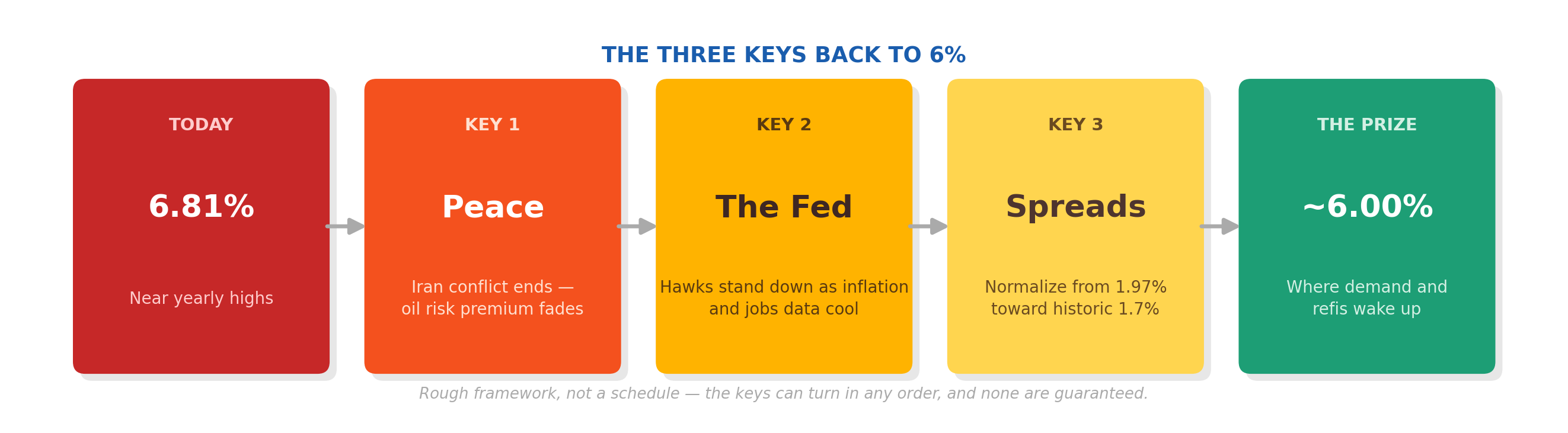
Key one: peace. When the conflict genuinely winds down -- not a one-week ceasefire, an actual end -- the oil risk premium fades and inflation gets room to cool. We've seen previews: on days when diplomatic headlines look promising, rates dip. The bond market is watching this like a hawk. Pun intended.
Key two: the Fed. Once inflation data improves -- and the labor market stops looking bulletproof -- the hawks lose their argument. The market goes from pricing hikes back to pricing cuts, and the 10-year yield -- the anchor mortgage rates hang from -- drifts down from its highs.
Key three: spreads. The gap between Treasury yields and actual mortgage rates is still running wide at about 1.97%, versus a historical norm around 1.7%. That gap alone is worth roughly a quarter point. It's already been the quiet hero of 2026 -- without improved spreads, today's rate would be closer to 7.4%. As markets calm, it has more room to shrink.
Turn all three keys and the math lands you right around 6%. That's not my wishful thinking -- the average of 21 economist forecasts tracked by Lance Lambert's ResiClub is 6.18% for 2026, and several of those forecasters see rates settling near 6% as the market normalizes.
The wild card: jobs
Inflation is only half of the Fed's math. The other half is the labor market -- and right now, it's holding strong. Unemployment is steady around 4.1%, and jobless claims have been running near generational lows. That strength is exactly what lets the hawks stay aggressive: no cracks in employment means no pressure to cut.
It also makes this week a big one. It's jobs week, and Mohtashami notes the hawks still need more votes to push a September hike through -- a hot jobs report could hand them those votes, while a soft one takes the hike off the table.
And here's the uncomfortable part nobody likes to say out loud: historically, the fastest road to rates falling decisively below 6% is a weakening job market that forces the Fed's hand. That's the 6% nobody should root for. The better version -- the one worth waiting for -- is the conflict ending, inflation drifting down while employment holds, and the Fed easing into a still-healthy economy. Slower, but that's the 6% that actually feels good when it arrives.
Why 6% is the magic number
This isn't just a round number people like. Real behavior changes at 6%.
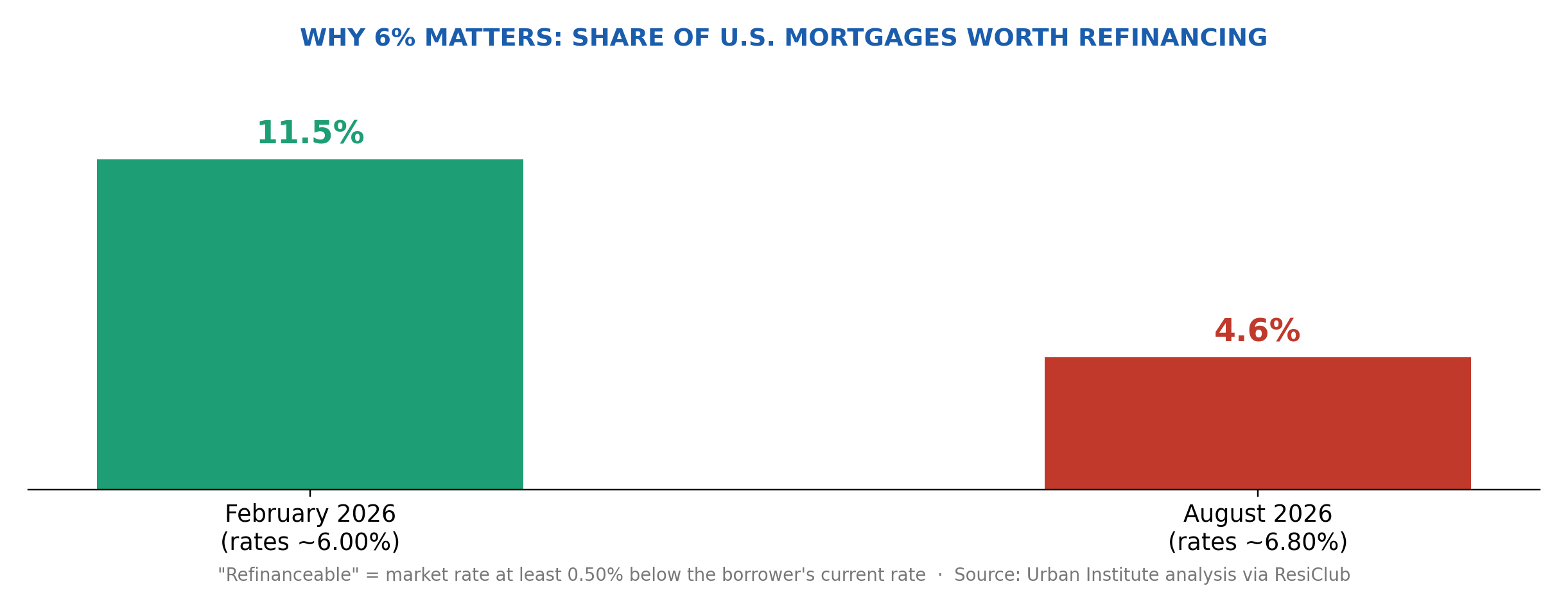
ResiClub reported something striking this month: back in February, when rates hovered near 6.00%, 11.5% of all U.S. mortgages were worth refinancing, per Urban Institute analysis. Today, at 6.8%? Just 4.6%. Every time rates approach 6%, refi activity buzzes to life. Every time they drift back toward 6.5%, it dies.
Same story on the buying side. Mohtashami's demand data shows housing activity grows when rates get near 6% and fades above his 6.64% line -- which is exactly what played out this year, in both directions.
So... will we?
- My honest read: yes, eventually -- but the calendar belongs to the conflict and the monthly jobs data. Nobody can tell you whether that's three months or twelve. Anyone who claims to know is selling something.
- If you're buying: don't build your plan around a rate that requires peace in the Middle East to arrive on schedule. Buy when the house and the payment work. If 6% shows up later, that's what refinancing is for.
- If you bought in the last year or two: keep your file handy. When rates approach 6%, the refi window opens fast -- and February proved it can slam shut just as fast. The people who win those windows are the ones who were ready before they opened.
The bottom line: 6% isn't a fairy tale -- it's eight months old. The path back runs through the end of the Iran conflict, inflation cooling, a job market that bends without breaking, and spreads doing the quiet work they've done all year. The pieces are all sitting on the board. They just haven't moved yet.
If you want to figure out what your move looks like at today's rate -- or build a plan for the day 6% comes back -- reach out. That's what I'm here for.
Questions about your mortgage or the market? I'm always happy to talk through your specific situation -- no pressure, no pitch.